AI capabilities extend far beyond generating isolated responses. The foundation of truly intelligent systems is Context Engineering, the deliberate design, structuring, and continuous management of the information that governs model behavior across interactions.
While prompt engineering focuses on crafting individual instructions, context engineering operates at a higher systems level. It ensures that AI understands who the user is, what they are trying to accomplish, and how prior interactions should influence future responses. Without context, even the most advanced models default to generic behavior. With it, they become adaptive, coherent, and genuinely useful.
AI models do not inherently remember intent, preferences, or history. They respond only to the information present within their active context. The quality, structure, and lifecycle of that context determines whether an AI system feels fragmented or intelligent, reactive or assistive.
The Engineering Imperative of Context Design
Applying engineering discipline to context design unlocks capabilities that simple prompting cannot achieve:
- Personalized Outputs at Scale: Structured user context allows AI systems to tailor responses based on identity, role, goals, and preferences, improving relevance and engagement.
- Consistency Across Interactions: Session and persistent memory prevent repetitive or contradictory responses, enabling stable behavior across multi-turn conversations.
- Support for Complex Workflows: Context-aware systems can reason across multiple steps, integrate tools, and adapt as new information emerges.
- Reduced Cognitive Load: Well-managed context eliminates the need for users to restate information repeatedly, creating smoother and more natural interactions.
Context engineering transforms AI from a stateless responder into a system that understands continuity.
What Is Context Engineering?
Context engineering is the practice of designing memory-aware AI workflows that enable systems to remember, adapt, and respond intelligently over time.
It involves:
- Structuring user identity and preferences
- Managing session-based and persistent memory
- Integrating tools and external knowledge sources
- Updating context dynamically as conditions change
Rather than treating each prompt as an isolated event, context engineering treats interactions as part of an evolving system state.
Personalized AI Responses Through Structured Context
By feeding structured user context into a model, AI outputs become more aligned with individual needs. Creating a user profile and injecting it into the prompt enables targeted and meaningful responses.
import os
from openai import OpenAI

os.environ["OPENAI_API_KEY"] = "sk-XXXXXXXXXXXXXXXXXXXX"

client = OpenAI()

user_context = {
  "name": "Alice",
  "role": "Software Engineer",
  "interests": ["AI", "Python", "Startups"]
}

context_prompt = (
  f"User {user_context['name']} is a {user_context['role']} "
  f"interested in {', '.join(user_context['interests'])}."
)

response = client.responses.create(
  model="gpt-5",
  input=context_prompt + "
Suggest Python project ideas."
)

print(response.output_text)
This approach ensures responses are grounded in who the user is, not just what they asked.
Memory-Aware Agents and Session-Based Context
Session-based memory enables agents to maintain coherence across multiple turns within a single interaction. By retaining user information in memory, AI agents can answer follow-up questions naturally without requiring repeated clarification.
from dataclasses import dataclass
from typing import Any, Callable, List, TypeVar, Generic
import asyncio

T = TypeVar("T")

@dataclass
class UserInfo:
  name: str
  uid: int

class RunContextWrapper(Generic[T]):
  def __init__(self, context: T):
      self.context = context

class Agent:
  def __init__(self, tools: List[Callable], memory: Any):
      self.tools = tools
      self.memory = memory

class Runner:
  def __init__(self, agent: Agent):
      self.agent = agent

  async def run(self, query: str) -> str:
      wrapper = RunContextWrapper(self.agent.memory)
      for tool in self.agent.tools:
          if "age" in query.lower():
              return await tool(wrapper)
      return "No suitable tool found."

async def fetch_user_age(wrapper: RunContextWrapper[UserInfo]) -> str:
  return f"The user {wrapper.context.name} is 47 years old"

agent = Agent(
  tools=[fetch_user_age],
  memory=UserInfo(name="Alice", uid=123)
)

runner = Runner(agent)

response = await runner.run("What is the user's age?")
print(response)
Session memory enables fluid, human-like conversations within a single interaction window.
Persistent Conversational Memory
Persistent memory extends continuity beyond a single session. AI systems can recall prior interactions even after a conversation ends, creating a long-term relationship with the user. Frameworks such as LangChain and LangGraph enable durable memory through checkpointing and state management.
import os
import uuid
from langchain_openai import ChatOpenAI
from langchain_core.messages import HumanMessage
from langgraph.checkpoint.memory import MemorySaver
from langgraph.graph import StateGraph, START, MessagesState

os.environ["OPENAI_API_KEY"] = "sk-XXXXXXXXXXXXXXXXXXXX"

workflow = StateGraph(state_schema=MessagesState)
model = ChatOpenAI()

def call_model(state: MessagesState):
  return {"messages": model.invoke(state["messages"])}

workflow.add_node("model", call_model)
workflow.add_edge(START, "model")

memory = MemorySaver()
app = workflow.compile(checkpointer=memory)

thread_id = uuid.uuid4()
config = {"configurable": {"thread_id": thread_id}}

msg = HumanMessage(content="Hello, I am Bob.")
for event in app.stream({"messages": [msg]}, config, stream_mode="values"):
  event["messages"][-1].pretty_print()

msg = HumanMessage(content="Do you remember my name?")
for event in app.stream({"messages": [msg]}, config, stream_mode="values"):
  event["messages"][-1].pretty_print()
Persistent memory enables continuity, trust, and more natural long-term interactions.
Dynamic Context Updates Through Tools and Memory
Context-aware tools allow AI systems to act based on stored user information and real-time data. By combining memory with tool execution, AI can retrieve relevant facts, customize outputs, and adapt responses dynamically.
from langchain_core.tools import tool
from langgraph.prebuilt import create_react_agent
from langgraph.checkpoint.memory import MemorySaver
from langchain_openai import ChatOpenAI

@tool
def get_user_age(name: str) -> str:
  """Returns the user's age based on their name."""
  if "bob" in name.lower():
      return "42 years old"
  return "41 years old"

memory = MemorySaver()
model = ChatOpenAI(temperature=0)

app = create_react_agent(
  model,
  tools=[get_user_age],
  checkpointer=memory,
)
Dynamic context updates enable AI systems to remain accurate and relevant as conditions change.
What Is Context in AI?
Context refers to the surrounding information that enables an AI system to interpret meaning correctly.
A single word can have multiple meanings depending on context. For example, the word “bank” may refer to a financial institution or the edge of a river.
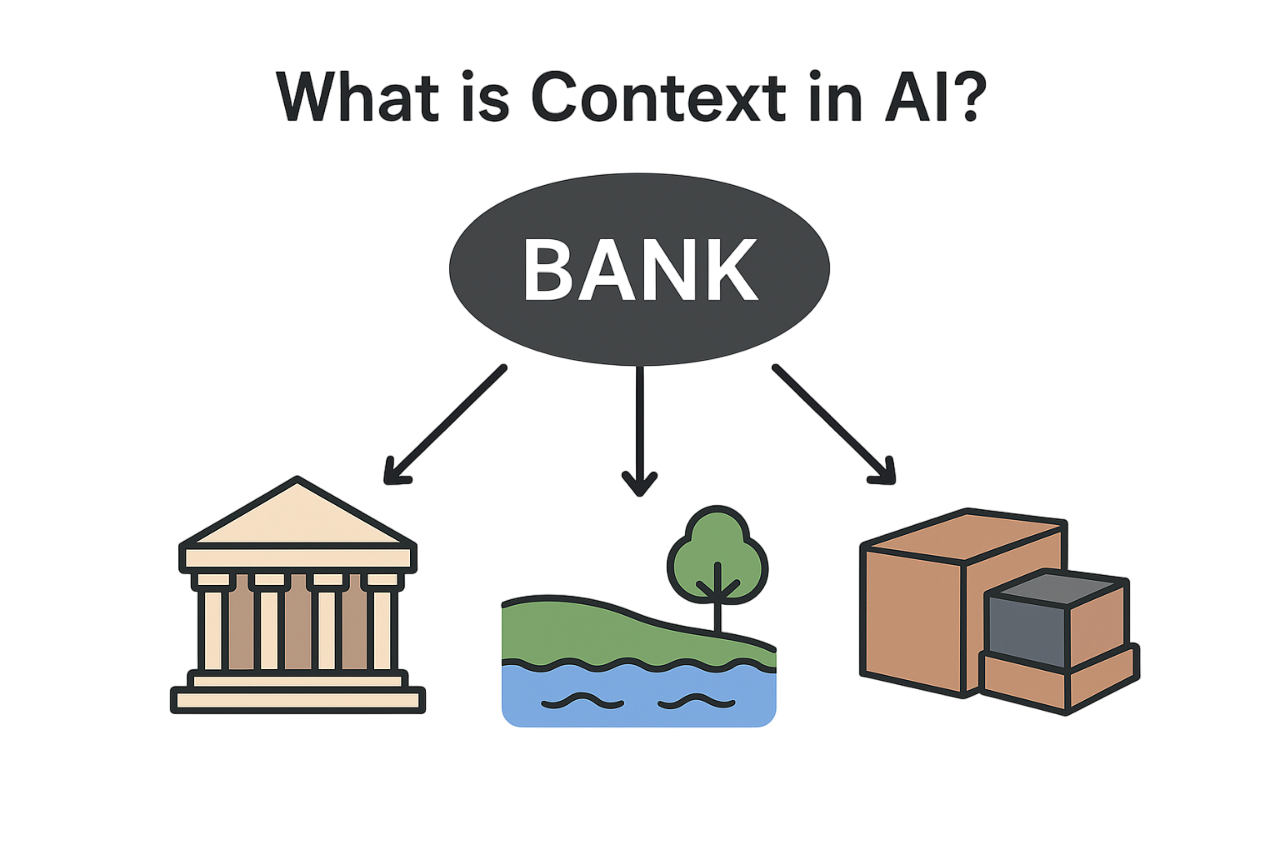
Context resolves ambiguity and guides interpretation.
The Role of the Context Window
A context window defines how much information an AI model can process at once. Larger context windows allow models to maintain coherence across longer conversations and more complex documents. Some modern models support extremely large context windows when accessed through APIs, enabling advanced reasoning over extensive inputs.
Excessive Context and Context Rot
More context is not always better. Providing excessive or irrelevant information can degrade performance, a phenomenon often referred to as context rot. When too much outdated or unrelated information accumulates, models may confuse old and new details, leading to inaccurate responses. Effective context engineering prioritizes relevance, recency, and structure.
Context Engineering Best Practices
Ensure context is intentional, concise, and structured.
Vague Prompt: Tell me about Paris.
Clear, Contextual Prompt: Provide a brief history of Paris during the French Revolution.
Clear context produces focused and accurate outputs, while vague context results in generic responses.
What Context Engineering Enables
- Personalized responses aligned with user preferences
- Memory-aware conversations across turns and sessions
- Smarter decision making through tools and stored context
- Natural multi-step workflows
- AI systems that feel consistent rather than repetitive
Final Notes
Context engineering means giving AI models more than instructions. It means providing situational awareness.
It answers four fundamental questions:
- Who the user is
- What they need
- When and where the interaction occurs
- Why it matters
When context is treated as a living system rather than a static input, AI evolves from reactive text generation into a proactive, adaptive assistant.
See you in the next issue.
Stay curious.
Join the Newsletter
Subscribe for AI engineering insights, system design strategies, and workflow tips.